
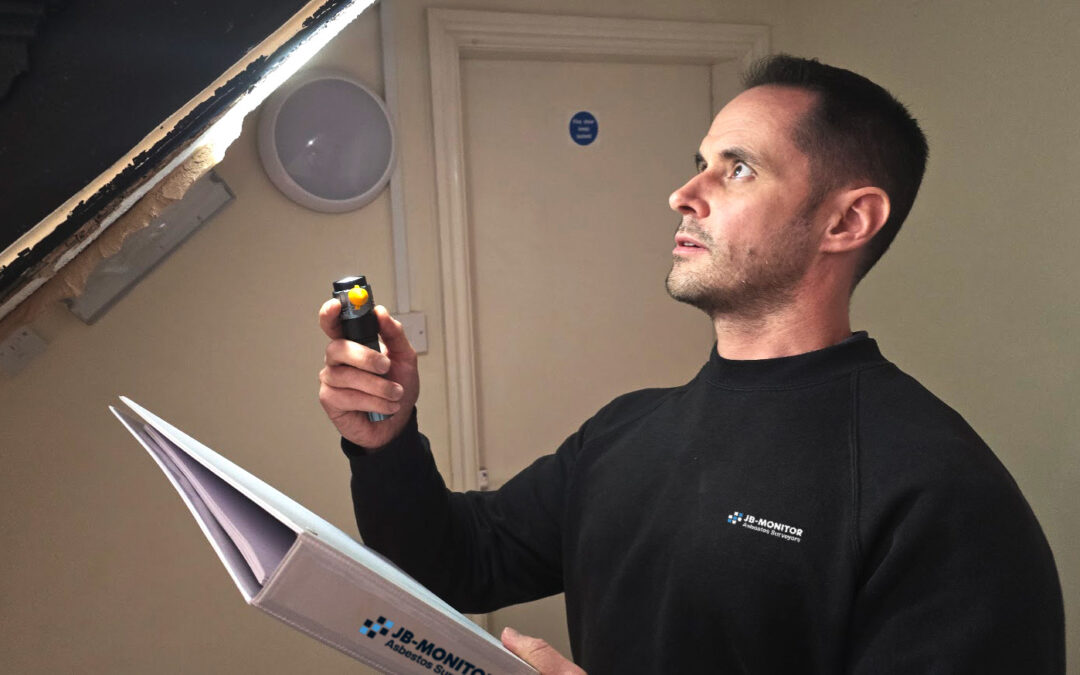
If you own, manage or are responsible for a building in Colwyn Bay or the surrounding area, there is a good chance the question of asbestos has come up at some point. It is an issue that affects a significant proportion of the region’s building stock, particularly properties constructed before 1999 when asbestos was finally banned in the UK. For anyone with legal responsibility for a non-domestic premises, having a professional asbestos survey in place is not optional. It is a legal requirement under the Control of Asbestos Regulations 2012, and it is the essential first step in managing asbestos safely and compliantly.
Why Colwyn Bay Buildings Are Particularly Relevant
Colwyn Bay has a varied building stock that spans several decades of construction activity. Victorian and Edwardian commercial premises along the high street and seafront are common. The town also has a significant number of mid-century commercial buildings, public facilities and industrial premises that were built or significantly refurbished during the period when asbestos was in widespread use. Asbestos was incorporated into a wide range of building materials during this era, including ceiling tiles, floor tiles and adhesives, pipe lagging, insulation board around structural steelwork, textured decorative coatings, corrugated roofing and certain spray-applied fire protection systems. Any building constructed before 2000 may contain one or more of these materials, and a professional survey is the only reliable way to find out.
The Legal Duty to Survey and Manage Asbestos
Regulation 4 of the Control of Asbestos Regulations 2012 places a duty to manage asbestos on anyone responsible for the maintenance or repair of non-domestic premises. This applies to employers, landlords, managing agents and facilities managers. The duty is not conditional on building work being planned. It applies simply because the person has responsibility for the building.
In practice, meeting the duty means knowing whether asbestos is present, knowing where it is and what condition it is in, assessing the risk, and having a written asbestos management plan in place that documents how those risks are being controlled. That plan must be kept current and must be made available to any contractor carrying out work that might disturb the building fabric. A professional asbestos survey is the foundation on which all of this sits.
The Three Types of Asbestos Survey
There are three types of asbestos survey, each required in different circumstances. All three are carried out in compliance with HSG264, the Health and Safety Executive’s official asbestos survey guidance.
Management surveys are the standard survey for buildings in normal everyday use. The surveyor carries out a thorough visual inspection of all physically accessible areas of the building, taking samples of suspected asbestos-containing materials (ACMs) for laboratory analysis. The resulting report includes a full schedule of every ACM identified, a condition assessment and risk score for each one, and a floor plan marking the location of all identified materials. This report forms the basis of the asbestos management plan. Survey reports can be supplemented by an asbestos register to support ongoing monitoring and management of ACMs over time.
Refurbishment surveys are legally required before any renovation, refurbishment or fit-out work begins in a building. They are more intrusive than management surveys and must cover the specific areas to be disturbed by the planned works. Identifying asbestos before contractors start is essential. Discovering it mid-project causes delays, additional cost and, in some cases, brings the whole project to a halt. A proper refurbishment survey ahead of time protects both the programme and the health of everyone on site.
Demolition surveys are required in full before any building is demolished. They cover the entire structure to identify all asbestos-containing materials so they can be safely removed before demolition work begins. This is the most comprehensive and intrusive survey type, and it must be completed before demolition contractors can start work.
What a Good Survey Report Should Contain
A thorough asbestos survey report is far more than a list of what was found. It should include the type of asbestos identified in each material, the location and extent of every ACM, a condition assessment describing the current state of each material, a risk score based on condition, accessibility and the likelihood of disturbance, a clear recommendation on whether each ACM should be removed, encapsulated or managed in place, and a detailed floor plan or building drawing marking the precise location of every identified item. This level of detail is what enables a duty holder to build a genuinely useful asbestos management plan rather than simply ticking a compliance box.
Choosing a Surveyor in Colwyn Bay
The quality of an asbestos survey depends entirely on the competency and accreditation of the company carrying it out. UKAS accreditation (from the United Kingdom Accreditation Service) is the key standard to look for. It confirms that the organisation’s methods, equipment and quality systems have been independently assessed and are actively monitored. Surveyors should also hold BOHS qualifications, specifically the P402 certificate for management surveys and P403/P404 for refurbishment, demolition and sampling work.
JB Monitor provide professional asbestos surveys in Colwyn Bay and across North Wales and the North West. Based locally in Colwyn Bay, they hold UKAS accreditation for surveying (ref 0294) and for their in-house laboratory analysis (ref 2075). All surveyors hold the relevant BOHS qualifications, every survey is carried out to HSG264, and sample analysis is handled at their own Colwyn Bay laboratory with 24-hour turnaround available by prior arrangement. JB Monitor are trusted by councils, utilities and construction contractors across the region for surveys, monitoring, training and consultancy.
North Wales: 01492 536 444 | Manchester: 0161 359 3684
www.jbmonitor.co.uk
Recent Comments